Post-Katrina NOLA, Episode III: "RECIPE"
View my complete profile

Sunday, November 22, 2009

Franz Building Update November 2009


Phyllis Cassidy, Executive Director of Good Work Network in New Orleans, announced at this year's 2009 Chase Community Development Competition that about 2/3 of the funding required to make the Franz Building renovation happen, has been raised to date!

btw...Wash. U./MIT placed second in this year's competition!

Friday, October 16, 2009

God's Vineyard update October 2009


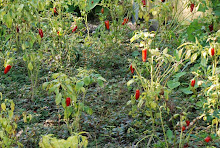
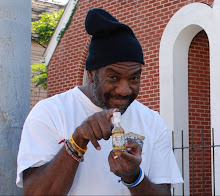
Fully functioning garden and first post-Katrina hot pepper sauce bottled!

Monday, June 1, 2009

NOLA Coop Installation

video

Sunday, May 10, 2009

Blog Article: "The Story of St. Thomas 7 Hot Pepper Sauce As Told by the Chickens Who Made It Possible"


Check out Inspired Economist article written by Kelli Peterson about NOLA RECIPE's continued work in New Orleans:

Tuesday, March 24, 2009

In Remembrance: Noel Jones


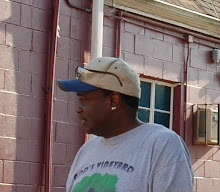
Our dear friend (and best client ever) Noel Jones passed on to a better place on Saturday, March 21, 2009.

All of us in NOLA RECIPE Studio remember how important he was, and will continue to be, as we move forward in our socially-conscious careers.

Structures for Inclusion Conference (SFI9)


Kathleen Johnson and Derek Hoeferlin present chicken coop at this year's SFI, hosted by Design Corps.

Friday, February 20, 2009

God's Vineyard Update February 2009


Derek Hoeferlin's Spring 2009 Wash. U. architecture and urban design studio of 10 students and Jane Wolff's and Elise Shelley's University of Toronto landscape architecture studio of 26 students visit God's Vineyard on February 7, 2009.

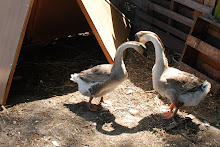
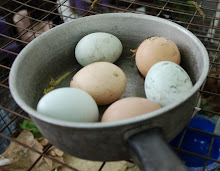
God's Vineyard co-directors Earl Antwine and Noel Jones present the mission of the garden and update the studios on the current state of the coops and garden. The chicken coop is appropriately dirty, fully functioning, fully resilient, and at full capacity. It is outputting dozens upon dozens of beautiful brown and green eggs for the community. The African Geese are happy in their separate goose coop too, despite damage the goose coop received from a wind-driven projectile.

At present, the garden has a new gang of volunteers, including John Kleinschmidt - former Hoeferlin student/RECIPE member and now New Orleans transplant/intern architect at Waggonner & Ball Architects. The garden is being tilled and seeded at time of this posting.

GREAT NEWS INDEED!!!

Monday, January 5, 2009

Coop Update January 5, 2009


Coop is holding up well, almost exactly 8 months after its assembly on site. Hardware is tight, all materials weathering properly, structurally sounds as ever, adjustable ventilation system of louvers and lapped roof segments working perfectly.


Chickens pecking around the now-empty hot pepper plot, helping to turn the soil over. The plot is ready for tilling in preparation for the next planting. (Pretty flat right now after record-breaking rainfall on Jan. 3) No foreign fertilizer will be necessary for the upcoming planting season - it will all come from the free-range chickens, ducks, geese, and turkey.


Louvers closed for the winter.


Well-used nesting boxes.

Thursday, November 6, 2008

Imagining America Conference


Derek presented his Wash. U. New Orleans design studios at IA conference in Los Angeles. He presented on panel with fellow CITYbuild members Dan Etheridge (Tulane) and Rob Corser (U. Washington) along with Mark Robbins (Dean of Syracuse Architecture School).


October 2, 2008

Sunday, September 14, 2008

BREAKING NEWS: Chicken Coop is Area of Last Refuge During Gustav

The NOLA Chicken Coop survived its first major test with hurricane-force winds during Hurricane Gustav. (Acually it has already withstood many tropical thunderstorms since its May '08 installation).

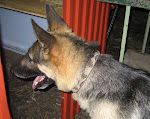
Not only did it not receive any damage from Gustav, it also served as "Coop of Last Refuge" for the chickens and also Rocky, the German Shepherd mascot of God's Vineyard!

Post-Katrina NOLA, Episode III: "RECIPE" -- Volume 01: NOLA Chicken + Goose Coop Prototypes

Click here to download (for free) or purchase a copy of the 487 page book documenting Chicken + Goose Coops portion of NOLA RECIPE studio. Proceeds go to Derek Hoeferlin's Spring '09 design studio, "Post-Katrina NOLA, Episode IV: OPERATION GUTTER TO GULF (or how I learned to stop worrying and love the water)"

Sam Fox School of Design & Visual Arts News Fall 08: "2 Projects, 1 City"


Hoeferlin's NOLA RECIPE studio featured in the Sam Fox School's innagural newsletter as representation for the Architecture school. The feature describes both portions of the studio, the chicken coop and the Franz Building renovation, the latter which one the 2008 JP Morgan Chase Community Development Competition.

Washington University in St. Louis Fall 2008 Magazine: "New Orleans Farm Transformed by Architecture Students"


Chicken coop featured in fall issue as one of the "FrontRunners" in education at Washington University in St. Louis.

Metropolis Magazine Article: "Experimenting with Disaster"


Derek's Spring '08 design studio's chicken coop featured in article about CITYbuild Consortium of Schools.
September '08
See pages 94-96 of following link:
http://www.metropolismag-digital.com/metropolis/200809/?sub_id=p68dlzCiB0Uw
Excerpt from Stephen Zack's nice piece:
"[The chickens have] adapted but are displaying no new forms of evolution. 'They still chickens,' he [Noel Jones] says. 'They're still doing their thing. But I think they're a lot more comfortable because they have a lot more space. So I think they are happier birds.'"

Tuesday, August 5, 2008

God's Vineyard Site Plan


Wednesday, June 25, 2008

NOLA Coop Computer Model

Exploded Axonometric of the Pre-Fabricated Components that would be delivered to given site "flat-packed" via cargo van...
Worm's Eye View of Assembled Coop (note: no floor to allow chicken droppings to directly fertilize ground)...
View from Above of Assembled Coop (note that nesting boxes are attached to larger roosting area; this allows one to directly access the nesting box and eggs directly from outside)...


Exploded Axonometric of all the Materials and Elements of the Chicken Coop (corrugated metal roofing and doors, galvanized steel structure, polycarbonate walls and louvers, wood nesting boxes, roositng bars, ramp and landing)...

Monday, May 26, 2008

"Franz Building: From Recovery to Rebirth" Available at Lulu.com


Monday, May 19, 2008

Press about RECIPE


"COOP DE GRACE: Students Give Facelift to God's Vineyard"
The Times Picayune
by Nina Wolgelenter
Thursday, May 22, 2008
http://www.nola.com/timespic/stories/index.ssf?/base/news-6/1211434466144930.xml&coll=1

"Architecture Students Win JP Morgan Chase Community Development Competition"
Record, Washington Univeristy in St. Louis
by Liam Otten
Monday, May 19, 2008
http://record.wustl.edu/news/page/normal/11801.html

"New Orleans Is the Site of Architecture Student Projects:
Class Creates Chicken Coop, Rehab Plan"
Record, Washington Univeristy in St. Louis
by Liam Otten
Thursday, May 8, 2008
http://record.wustl.edu/news/page/normal/11706.html


"Central City Project Wins Student Contest: Prize Is $25,000 to Start Renovation"
The Times Picayune, by Rebecca Mowbray, Thursday, May 8, 2008
http://www.nola.com/timespic/stories/index.ssf?/base/library-147/1210225092270110.xml&coll=1

"College Students’ Plan to Restore Historic New Orleans Building and Revive O.C. Haley Boulevard Earns $25,000 in Chase Competition"
http://www.businesswire.com/portal/site/home/news/sections/?ndmViewId=news_view&newsLang=en&newsId=20080507006391

"Central City Incubator Moving Forward"
http://www.neworleanscitybusiness.com/uptotheminute.cfm?recid=17203


WWL TV Eyewitness Morning News Interview- May 7, 2008

Wash. U./MIT Team Wins 2008 JP Morgan Chase Community Development Competition!

pictured from left to right: Leigh Heller (WU), Kathleen Johnson (WU), Lizzy Bochner (WU), Alla Agafonov (WU), John Kallenborn (New Orleans President of Chase), Claudia Bode (WU), Ed Blakely (Executive Director for Recovery Management), Lakshmi Sridaran (MIT), Holly Jo Sparks (MIT), Andrew Stern (WU), Johnny Chen (WU), John Kleinschmidt (WU), Derek Hoeferlin (WU Faculty Advisor), Not Pictured: Nick Berube (WU), Aaron Williams (WU), Karl Seidman (MIT Faculty Advisor), Phyllis Cassidy (Good Work Network Executive Director)
(photo- Martinez Photography)

The 2008 JPMorgan Chase Community Development Competition was held in New Orleans. This real world learning experience gives a team of students an opportunity to partner with a New Orleans nonprofit organization to develop a real estate project that is feasible, sustainable, and helps to build and strengthen the local community.

Download the full competition submission pdf titled
"The Franz Building: From Recovery to Rebirth" at:

http://www.enterprisecommunity.org/local_work/gulf_coast/chase_competition.asp

Monday, May 12, 2008

The Chase Competition Presentation + WWL TV Interview

left to right: Holly Jo, Lakshmi, Alla and John deliver presentation to jury at Loews Hotel in New Orleans, May 6, 2008

Alla Agafonov's rendering of a restored Franz Building OC Haley Blvd. elevation

Johnny Chen's sectional perspective of a renovated Franz Building

Johnny Chen's and John Kleinschmidt's rendering of Good Work Network's "Public Presence Flexible Space" looking out a restored Franz Building storefront towards OC Haley Blvd.

John and Lakshmi interviewed on WWL TV

The Test: The Chickens' (and Geese's) Approval.


night shots: note diagonal roosting bars with silhouettes of chickens


chickens actually roosting
polycarbonate translucent panels and transparent louvers, galvanized perforated steel frame, corrugated min-rib metal roof, and plywood nesting boxes with hay inlay


goose coop


Set up of the Coops at God's Vineyard, NOLA

Rebuilding the chicken coop for the third time in its permanent location in the garden:

Components after unloading from cargo van


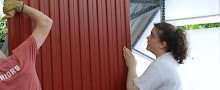
Sequence of Assembly


pictured left to right: Kathleen, Noel, Lizzy, Leigh, Claudia, a chicken, Andrew, Johnny, Derek

The Breakdown of the Chicken Coop

The coop: as visible from outside the community garden.


The client with the coop:


The Building Process:


FOUNDATION

The foundation is made of concrete boots inset with short perforated metal angles.


The foundation has to be laid once the coop is assembled to guarantee orthogonal orientation of the coop structure.


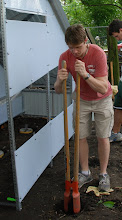
The dirt is dug out from underneath the coop, the boots are set in, and then the coop is bolted to the angles.


STRUCTURE:

The coop is put together with perforated steel angles allowing for mostly nut and bolt connections and a minimal amount of drilling.


Steel angles are used for bracing and supporting.


ENCLOSURE:

The polycarbonate panels act as bracing as well as enclosing the coop. The panels are perforated with louvers that allow for cross ventilation.


The panels all come apart as individual parts of the coop.


The roof is slightly lifted from the framework allowing for cross ventilation in both directions

The corrugated roof directs water and debris down the coop and can double as water collection.


The corrugated panels make up both the sliding chicken door and human door

(2-foot tall chicken door pictured).

The Drive: StL to NOLA


The chicken coop kit of parts, as well as the model driving in a 15 person passenger van to New Orleans with John and Alla.


Saturday, May 10, 2008

Final Review on Second Floor of Givens Hall, Wash. U. School of Architecture


The coop lit up from the inside with candles.


Thursday, May 1, 2008

04-29-08 Puting together all the pieces

Wednesday, April 30, 2008

04-27-08 FABRICATION

The fabrication process:


Derek....."how much will it wrack?"

Wash. U./MIT Team Named Finalist for Chase Competition!

Sunday, April 27, 2008

4-26-08 polygal

Back to the shop. Making the final cuts.


video
making the cuts on the table saw.


making the last official cut of the polygal. It is much cleaner to just do it by hand so all the diagonal lines had to be cut with an exacto knife.


proof that leigh showed up.

measuring out the roosting bars.


measuring out the holes after the polygal was cut.


the last hours in studio.

4-25-08 12:00am

This is our 11:00pm-2:00am meeting. What are we doing again?


Figuring things out........again.


This is how it needs to be put together.


What about.........?
(the discussions last for a while)


Not another issue that needs to get resolved......why didn't we just think about this earlier?


Well, just do it anyways.


Frantic measuring.


more measuring

a nap.

thats it, I'm done!

Saturday, April 26, 2008

4-24-08 Last official day of studio!


Studio. Progress is far slower than expected as many things must be figured on the spot but all is coming together.

figuring out the metal cuts, roosting bars, and other details.


Cutting the corrugated sheet metal with a band saw. We realized that the guides were slightly slanted and had to guide it by hand.
video

Making the first practice cuts.


After many hours of figuring out the correct way to cut. Three pieces finished, four more to go.


Aaron building the goose coop.


The nesting box built.


We realized the bolts are too big, which means another trip to home depot, one of 20 or so trips that have already been made.


Taking apart the nesting box.

Wednesday, April 23, 2008

Now that the frame is figured out, we have made the necessary markings and we have cut all the pieces to size. Here is what the process entailed:


translating the drawings, checking the dimensions

marking each angle


cutting and reorganizing


hosing down the angles


A meeting with Derek and Leland to figure out the louvers


The nesting box is concurrently being drawn up to be cut.


The base of the coop will be made of these concrete feet that will bolt to the frame according to the proper leveling of the coop.

Tuesday, April 22, 2008

Back to the Chicken Coop


Now that we have all of the materials, we are making minor changes to the dimensions as well as checking that everything will connect well.


video


While the polygal corrugated plastic is fairly light, together it will have some significant weight.

Saturday, April 12, 2008

Latest Pages

These are basic drafts of layout without graphics. The table of contents is to be expanded. Some of the words for the sub chapters need to be changed. The executive summary needs to be added as well as the financial analysis which should add about 6 more pages.


Wednesday, April 9, 2008

Rough pages of the Sustainability Section

These are rough page layouts with section heading highlighted and brought to the top. Images are currently being updated and inserted in the slots.

This is using a heading that is highlighted but stacked with the other headings.

Franz Building Site Model


Tuesday, April 8, 2008

Alternate version

These are organized with new titles running along the side highlighting the subject of the page.

Monday, April 7, 2008

Chase Competition Mock-Up's 4-7-'08


There are the first rough pages of the report.

Franz Building Design Update 4-1-08

Below is the current state of proposed designs for the 10 students.
These have been uploaded for review by Good Work Network and M.I.T. for the purpose of further development leading up to Chase Grant competition deadline on April 18, in addition for use as preliminary cost estimating by contractors in New Orleans.

Friday, April 4, 2008

Franz Building Existing Dimensions + Area Calculations


Nick Berube


Thursday, April 3, 2008

Aaron Williams

Tuesday, April 1, 2008

John Kleinschmidt


Flexible space that can serve groups of 12 people (meetings), 25 people (classes), or 80 people (graduation and evening events) is the public space of the Franz Building and thus occupies the O.C. Haley edge with storefront windows. A transparent public face is important for a business incubator. Breaking down the bearing wall allows Good Work to take ownership over the entire space that they will occupy. Small offices are the private space and thus occupy the south end of the building with smaller windows. Two conference rooms with computers mediate between the public and private. The east and west walls of these two rooms store sliding wall partitions for dividing and closing the flexible space. The north and south walls of these two rooms are sliding glass panels, so the rooms can be linked with either the private area of the offices or the public area of the flexible space. A raised bamboo floor over the office area is countered by a suspended ceiling over the flexible space, director’s office, kitchen, and bathrooms. The plenum floor allows for efficient wiring of the offices; the suspended ceiling reflects light and allows for the flexible space to become soundproofed by the sliding walls.


Monday, March 31, 2008

Andrew Stern

The following images display a possible scheme for the redesign of the Franz Building. The main driving force considers how light wells and ceiling plane interventions help to define spatial conditions on the ground plane.


Johnny Chen


The Good Work Company requires the Franz renovation to synthesize a large, uninterrupted space for meetings with smaller office spaces that are conducive to one on one consultations. A main challenge for this project is to fit these two different types of spatial conditions into a building that has a well-defined rhythm of bays. (expressed both in the building’s structure and on its front façade)

The organizational strategy of this scheme is to designate a program (small offices, large offices, flexible space) to each bay. The small offices line the two outside bays, the large offices occupy the third bay (from Josephine street), while the flexible space fills the entire second bay. By stretching the entire length of the bay, the flexible space has direct access to an outdoor patio space while maintaining a public front. By keeping that bay open, it also allows for light to enter from both the front and the back of the building.

The other utility spaces such as bathrooms, kitchen, computer lab, and storage are also aligned within these bays in order to maintain natural light exposure, and to allow for clear, direct circulation paths. In order achieve connectivity (visual and physical) between the bays, openings are punched through the structural spine wall.

Kathleen Johnson

In order to allow the Goodwork Network to occupy the Franz Building, several changes must be made. Due to the historic value of this building, I have developed a scheme which mostly involves the restoration of the existing building. There will be several walls added to divide the spaces, yet these will not simply be typical office partitions. The Goodwork network should be visible to the community, yet there is also a degree of privacy necessary in a business setting. In order to achieve this visibility the partitions will allow for differing degrees of transparency, according to the needs of the program. What follows are plans showing the most drastic changes made to the existing building, as well as diagrams of how the program will be laid out.

Claudia Bode

Following is a summary of my idea for the Franz Building: a new space that allows for maximum communication and integration between the neighborhood and the building, and between employees of Good Work. Previous iterations are provided as a reference for process.


Lizzy Bochner


Sunday, March 30, 2008

Alla Agafonov


The first few pages describe the existing conditions and the possibilities of arranging the program requested. As can be seen from the photographs the building has inherent beautiful features that can be taken advantage of: the wood joist/ truss roof, ceramic block walls and high ceilings. The roof can be used as a unifying object connecting all the smaller spaces just by allowing it to be completely exposed. This is where the high ceilings have a significant role because creating partitions that only block the view from one office to the next only up to the sight line allows for a great view of the entire space. Leaving the ceramic block exposed as well gives the area the quality of its original condition. To emphasize the openness and full scope of the space within the ceramic walls the smaller offices are cut down just enough so that a person at a desk and one across could sit comfortably. In order to make the entire complex efficient different programs are clustered together based on their requirements. All of the programming that requires plumbing is in one bay, one bay is left completely open for the flexible space, and the other two are all office space. This allows for minimal destruction of the existing structure within while also defining the different spaces.

Leigh Heller


Friday, March 7, 2008

"Restored condition" renderings


These are two renderings of the way the Franz building could have looked originally, or how it could look if it were restored to its original condition. While we are each pursuing individual schematic designs for the building, this is a first stage for understanding the building as it was meant to be seen.
- Claudia


Wash. U. and M.I.T. advance to Phase 2 of Chase Competition

Our studio has teamed up with students and faculty advisor Karl Seidman at Massachusetts Institute of Technology for the JPMorgan Chase Community Development Competition. We will be submitting the Franz Building project on behalf of our New Orleans' nonprofit partner, the Good Work Network. After submitting the initial project abstract proposal, our team was selected as one of nine finalists to continue forward, with an awarded stipend. The deadline is April 18 for final written proposal, and if selected for the final six, the oral presentations will be held in New Orleans on May 6.

"The JPMorgan Chase Community Development Competition gives a team of students an orrortunity to partner with a New Orleans nonprofit organization to develop a real estate project that is feasible, sustainable, and helps to build and strengthen the local community."

Congrats on advancing to the next round!

Hey this is Leigh,
Here is an updated version of my exterior rendering of the Franz Building. I rendered it as being fully refurbished and remodeled to a new and improved version of its existing condition, and removed the dilapidated buildings and powerlines surrounding it. It might leave the picture a little out of context, but it alows the Franz Building to be the focus of the rendering, and allows you to see how beautiful this building could be even in just a restored state with no new designed elements.

Tuesday, March 4, 2008

Week 3 of Franz Building Project: Revised Renderings & Schematic Designs


Alla Agafonov

Thursday, February 28, 2008

Week 1-2 of Franz Building Project: Site Models & Perspective Renderings

Since returning from our field tip to New Orleans, the studio has focused on two tasks:
1) Constructing site models of the Franz Building and surrounding Central City neighborhood context and;
2) Beginning initial design studies through an exercise of perspective renderings. Each student was asked to construct at least one exterior and one interior view of his/her initial interests. Once completed, these renderings were transmitted to the Good Work Network as a first in a series of deliverables. The purpose of this deliverable is to present ideas to the Board at Good Work. After revisions over the course of the forthcoming week, these renderings will be used for fund-raising purposes.


Alla Agafonov


Nick Berube
Lizzy Bochner
Clauida Bode

Johnny Chen


Leigh Heller


Kathleen Johnson

John Kleinschmidt


Andrew Stern


Aaron Williams

Tuesday, February 19, 2008

CHICKEN COOP WINNER ANNOUNCED!

Noel and Earl have chosen a winning scheme.
The red coop by Alla, Claudia and Kathleen.
Congrats!

Thursday, February 7, 2008

Alla, Claudia, and Kathleen revise materials


After our review we decided to revise some of our material decisions. This is an array of possible choices for the exterior materials. All have variant costs that have to be considered but the design is possible in all configurations.

Monday, February 4, 2008

Alla, Kathleen, Claudia

My original scheme inveolved a large roosting area which could be seperated from a smaller nesting area. The nesting boxes are small enough to be transported in one piece, while the roosting area needs to fold or come apart for transportation. These ideas are still present in the coop that Alla, Claudia, and I created by merging our schemes together.

After Friday's review it is necessary for us to rethink our material choices. We originally clad the coop in wood and corrugated plastic, but then found a lighter PVC foam (Komatex), and Coroplast twin wall sheeting. While these materials are lighter, and a little more unusual, they are not good for the environment.

Sunday, February 3, 2008

Alla, Kathleen, and Claudia


We consolidated our separate ideas into one project and this is the last sketch model. The conclusion that we reached was that the shape of the coop be orthogonal for easy construction, nesting box be separate from roosting area in that it can be removed for cleaning, the nesting box be lifted off the ground for easier access, the entire coop have the ability to be transported in pieces or panels that fit in a cargo van, the structure be made of steel angles with opaque plastic on the roof and two side walls and translucent plastic panels on the other sides.


The framework.

The separate panels.

The nesting box.

Viola, a chicken coop makes a great addition to any back yard.

Alla's first attempt


I began looking at how to break up the space so that the shape of the coop is a reflection of the basic functions of a coop. A larger area is devoted to roosting, the access from the inside is only to the roost, the lowered area is devoted to nesting, which is accessible from the outside, and it is all made of as little planes as possible.


This is another variation that is more orthogonal making it easier to build, as well as having the ability to expand by removing one of the side walls and joining a second identical unit.

Tuesday, January 29, 2008

Noel's Existing Coop


Chicken Coop Links

http://www.plamondon.com/chicken-coops.html
http://www.motherearthnews.com/Green-Home-Building/1992-06-01/All-Cooped-Up.aspx
http://www.organicgardening.com/pdf/coop_plans.pdf (similar to Aaron's propsal)
http://www.backyardpoultrymag.com/issues/1/1-1/Dennis_Harison-Noonan.html
http://www.backyardchickens.com/coopdesigns.html
http://www.mypetchicken.com/ebook.aspx?Chapter=5
http://mdfarm.blogspot.com/2007/05/mobile-chicken-coop.html
http://www.google.com/search?hl=en%26rls=RNWE%252CRNWE%253A2005-29%252CRNWE%253Aen%26q=chicken%2Bcoop+
http://www.youtube.com/results?search_query=chicken%2Bcoop
http://www.chickencoopplan.com/ (contact this guy to get his free plans)

Monday, January 21, 2008

Drafts and Portability

It is interesting to design something that will be used by animals; completely different from considering human scale alone. Also, it turns out that chickens have some strange habits and preferences which must be considered. For example, to stay warm they create a cushion of air with their feathers, so sleeping in a drafty area can kill them. But, a good chicken coop must also have adequate ventilation.
One of the biggest problems that I have encountered so far is the problem of portability. I want the coop to be big enough to allow the owner to walk inside, yet able to be moved by just two men. It would also be a plus if it could fit into the back of a standard pickup, since the garden may relocate. This has lead me to design a coop that has two distinct pieces that lock together; one for nesting and one for roosting. The larger of these two areas, the roosting area, will have hinged walls that will fold flat for transportation. The roof over the nesting box will lift to allow egg collection from outside the coop. I do have some reservations about including too many hinges, since they wear out and break over time. I suppose that the lifespan of this coop will probably be determined by the movable parts, because the rest of it will be a simple frame with attached panels.
-Kathleen

Lizzy Nick and Andrew

Designing a chicken coop has been more difficult than expected! Its interesting how such a relatively simple design problem has posed more issues than with more complex programs. A program of this nature requires complete development of efficiency, effectivness, accessibility (for chickens and humans).

One design idea has involved using a track system, similar to those on barn doors, that allows for flexibility of enclosure and accessibility. A system like this may enhance the overall success of a chicken coop for humans and chicken alike.

Here's the link to our work!

file://F:\CHICKENS

First Blog

Hey this is Leigh,

So this is my first blog actually, which is pretty neat. But the studio so far is really interesting and somewhat unconventional, which I like a lot. Doing the chicken coup project, which is at a smaller scale to a building is proving to be quite a challenge. But I have already learned about 10x as much about chicken coops as I knew before, and it's funny how similar the division of space for chickens parallels that of humans. Each needs their own amount of space and each is very picky about the type.

Right now I am starting to explore the concept of this chicken tractor idea, as far as the portability aspect of it, and synthesizing that idea with a more stationary form of a coop. Rather than mobility being the focus of my coop, it is more so an option, but it is one that forces all the other elements to account for it. So weighting and balance of the design has to account for the mobility; almost like a suitcase where heavy things are backed at the bottom closer to the wheels to aid the feasibility of travel.

At the beginning now, I am keeping the design very simple and weight/balance driven. Design-wise it is nowhere near where I want it to be, but that is fine, its just the foundation to which I will branch out and then start to bring in the characteristics and ideas my partner Aaron and I have been exploring. I'm looking forward to it!

Thursday, January 17, 2008

First Impressions


I love this studio.
Eric